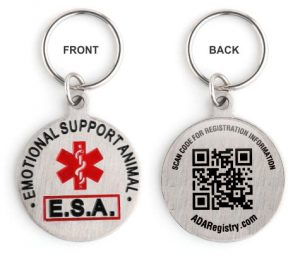
Service Dog – ESA DOG Travel Related Issues?
Emotional Support Dogs, Service Dogs & Your Legal Rights
Laws concerning emotional support animals, service dogs, housing, public access, and air travel are different from one another. The rules that apply depend on where you are taking your dog and what type of assistance the dog provides.
This information reflects current federal rules and guidance and is provided for general educational purposes.
Emotional Support Animals vs. Service Dogs
An emotional support animal (ESA) provides emotional support or alleviates symptoms or effects of a person’s disability through its presence.
A service dog is different. Under the Americans with Disabilities Act (ADA), a service animal is a dog that has been individually trained to perform work or tasks directly related to a person’s disability.
For example, a dog trained to detect an impending panic attack and take a specific action to help the person may qualify as a psychiatric service dog. A dog whose presence simply provides comfort does not qualify as a service animal under the ADA.
The ADA does not require a service dog to be professionally trained. A person with a disability may train their own dog.
Does a Service Dog Need to Be Registered or Certified?
No.
The ADA does not require service dogs to be registered, certified, licensed as service animals, or accompanied by a government-issued identification card.
A business generally cannot require documentation proving that a dog has been certified, trained, or licensed as a service animal.
When the disability or the need for the dog is not obvious, a covered business or public entity generally may ask only:
- Is the dog required because of a disability?
- What work or task has the dog been trained to perform?
A business generally cannot demand medical records, a doctor’s letter, certification papers, or registration documents as a condition of ADA service-animal access.
A voluntary ID card or registration may be useful for identification or convenience, but an ID card or registration does not create legal service-dog status.
Public Access Under the ADA
Generally, businesses and state and local government entities covered by the ADA must allow qualified service dogs to accompany people with disabilities in areas where members of the public are allowed to go.
This generally includes places such as:
- Restaurants
- Stores
- Hotels
- Hospitals
- Government buildings
- Public transportation
- Other businesses and facilities open to the public
A business with a “no pets” policy generally must still permit a qualifying service dog.
A service dog may be excluded in limited circumstances, including when the dog is not housebroken or is out of control and the handler does not take effective action to control it. A service animal may also be excluded when its presence would fundamentally alter the nature of a covered service or program.
Allergies or fear of dogs generally are not valid reasons by themselves to exclude a service dog.
Emotional support animals do not automatically receive the same public-access rights under the ADA.
State and local laws may provide additional protections or may recognize animals more broadly in certain situations.
Housing and Emotional Support Animals
Housing is different from public accommodations and air travel.
The Fair Housing Act (FHA) can provide protections for qualifying assistance animals, including animals that provide emotional support related to a person’s disability.
Depending on the circumstances, a housing provider may be required to make a reasonable accommodation allowing a qualifying assistance animal even when the property has a no-pets policy.
A housing provider may be permitted to request reliable information when the disability or disability-related need for the animal is not apparent.
Housing providers generally may not treat a qualifying assistance animal simply as an ordinary pet for purposes of pet-related rules and charges.
However, housing providers may apply reasonable rules relating to conduct, health, safety, and property damage, subject to applicable law.
Important 2026 Update
Federal housing enforcement policy has changed, and older HUD guidance that appears on many websites should not be presented as current law.
HUD withdrew certain prior FHEO guidance in 2025, and HUD subsequently changed its enforcement approach regarding assistance animals. These policy developments do not mean that the Fair Housing Act itself was eliminated or that all emotional support animals automatically lost housing protections.
Housing rights should therefore be evaluated under the current Fair Housing Act, applicable regulations, and current HUD policy rather than older ESA websites or outdated guidance.
Emotional Support Animals and Air Travel
Air travel is governed by the Air Carrier Access Act (ACAA) and U.S. Department of Transportation regulations.
The current DOT rules are different from the older rules that once treated emotional support animals more like service animals.
Emotional Support Animals Are Not Service Animals Under Current DOT Rules
Under current DOT rules, airlines are required to recognize dogs as service animals when they are individually trained to perform work or tasks for the benefit of a qualified person with a disability.
Emotional support animals, comfort animals, companion animals, and service animals in training are not considered service animals under the current DOT definition.
An ESA may still be permitted to travel by an airline, but it may be subject to the airline’s rules for pets or other animals.
An ESA letter does not give an emotional support dog automatic service-animal rights on an airplane.
Psychiatric Service Dogs on Airplanes
A psychiatric service dog may qualify as a service animal under the ACAA when the dog is individually trained to perform work or tasks for a person with a psychiatric or other mental disability.
For example, a dog trained to perform a specific action in response to an anxiety or psychiatric condition may qualify.
The important distinction is training to perform disability-related work or tasks, rather than the dog’s ability to provide comfort simply by being present.
Does a Service Dog Need a Doctor’s Letter to Fly?
Generally, a doctor’s letter is not what establishes a dog’s status as a service animal.
However, airlines may require passengers traveling with service dogs to complete U.S. DOT service-animal forms concerning the dog’s health, behavior, and training.
For flights lasting eight hours or more, an airline may also require a DOT service-animal relief attestation.
Airlines generally cannot require unrelated documentation simply because a passenger is traveling with a service dog.
DOT Service Animal Forms
An airline may require the appropriate U.S. DOT forms for a service dog.
The forms may address:
- The dog’s health
- The dog’s behavior
- The dog’s training
- Whether the dog can relieve itself during a long flight without creating a health or sanitation problem
The DOT has updated its service-animal forms and currently provides them through its aviation disability resources.
Travelers should check their airline’s current requirements before traveling.
Can an Airline Ask Questions About a Service Dog?
Yes.
An airline may determine whether an animal qualifies as a service animal by:
- Asking whether the dog is required because of a disability; and
- Asking what work or task the dog has been trained to perform.
The airline may also consider the dog’s behavior and whether the dog is harnessed, leashed, or otherwise controlled.
A service dog must behave appropriately in the airport and aircraft cabin.
Can an Airline Refuse a Service Dog?
An airline may refuse transportation of a service dog in certain circumstances, including when:
- The dog poses a direct threat to health or safety;
- The dog causes a significant disruption;
- The dog engages in disruptive or uncontrolled behavior;
- Transportation would violate applicable health or legal requirements;
- The dog cannot safely be accommodated in the cabin; or
- Required DOT service-animal forms have not been provided when properly required.
A refusal must be based on the applicable DOT requirements and, where required, an individualized assessment rather than simply a person’s fear or discomfort with dogs.
Service Dogs and Airline Fees
Airlines generally may not charge a passenger a pet fee for a qualifying service dog that is accepted for carriage under the ACAA.
This does not mean every cost associated with travel is automatically waived. Normal airline rules concerning seating, safety, international entry requirements, and other applicable requirements may still apply.
Service Dogs and Seating
A service dog must generally be accommodated in the space at the passenger’s seat.
The dog cannot block an aisle or other space that must remain unobstructed for safety.
An airline is not required to move a passenger to a different class of service solely to accommodate a service dog.
Travelers should contact the airline before departure if they have special seating needs.
Traveling Internationally With a Service Dog
Traveling internationally can involve requirements in addition to U.S. airline rules.
The destination country may have its own requirements for:
- Animal entry
- Vaccinations
- Health certificates
- Microchips
- Quarantine
- Import permits
- Documentation
A U.S. service-dog designation does not automatically satisfy another country’s animal-entry requirements.
Travelers should check the requirements of every country they will enter or transit before departure.
Advance Notice to an Airline
Passengers are generally not required to provide advance notice for ordinary disability accommodations.
However, DOT rules permit airlines to require up to 48 hours’ advance notice in certain circumstances involving disability accommodations.
Because airline procedures can vary, travelers should contact their airline in advance whenever possible, particularly when traveling with a service dog or requesting a special accommodation.
What About an ESA Letter?
An ESA letter may document that a licensed healthcare professional believes a person has a disability-related need for an emotional support animal.
However, an ESA letter does not:
- Turn an ESA into an ADA service dog;
- Create public-access rights under the ADA;
- Guarantee airline access as a service animal;
- Replace required DOT service-animal forms;
- Create a government certification; or
- Automatically establish housing eligibility in every situation.
The legal significance of documentation depends on the particular law and situation involved.
Identification Cards, Certificates and Registration
There is no federal government database that a person must use to register a service dog under the ADA.
A service dog is not legally created by purchasing:
- An ID card
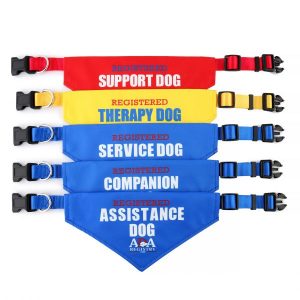
- A vest
- A certificate
- A registration
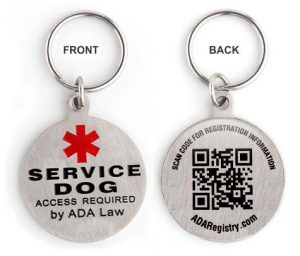
- A tag
- An online listing
These products may provide identification or organizational convenience, but they do not independently establish legal status.
For this reason, identification products should never be represented as government-issued certification or as a guarantee of legal access.
Traveling With Your Dog: Before You Leave
Before traveling, consider:
- Determine whether your dog is an ESA or a trained service dog.
- Check the current rules of your airline.
- If traveling with a service dog, determine whether DOT forms are required.
- Make sure your dog is properly trained and under control.
- Check destination-country requirements for international travel.
- Contact TSA for security-screening questions.
- Contact the airline’s CRO if you encounter a disability-related problem.
If You Have a Problem With an Airline
Ask to speak with the airline’s Complaint Resolution Official (CRO).
Airlines are required to make a CRO available, at no cost, by telephone or in person during operating hours to address disability-related complaints.
U.S. Department of Transportation Disability Hotline
1-800-778-4838
Hours: Monday–Friday, 9:00 a.m.–5:00 p.m. Eastern Time, when the federal government is open.
Telecommunications Relay Service
711
TSA Cares
For disability-related airport security questions:
1-855-787-2227
TSA recommends contacting TSA Cares at least 72 hours before travel when a traveler wants assistance from a Passenger Support Specialist.
TSA Contact Center
For general TSA security questions:
1-866-289-9673
U.S. Department of Transportation
Office of Aviation Consumer Protection
U.S. Department of Transportation
1200 New Jersey Avenue, SE
Washington, DC 20590
DOT General Information: 855-368-4200
Important 2026 Reminder
Federal rules concerning service dogs, emotional support animals, housing, and air travel are separate and can change independently.
Do not assume that a rule applying to housing also applies to restaurants, stores, airplanes, or other public places.
In particular:
Housing: Emotional support animals may receive protection as qualifying assistance animals under the Fair Housing Act.
Public accommodations: The ADA generally protects individually trained service dogs, not animals whose sole function is emotional support.
Air travel: Current DOT rules recognize individually trained service dogs as service animals; emotional support animals are not treated as service animals under the ACAA.
Identification: Federal law does not require an ADA service dog to have a registration, certification, vest, or ID card.
For the most current requirements, consult the applicable federal agency and the airline, housing provider, or business involved.
Disclaimer: This information is provided for general educational purposes and does not constitute legal advice. Laws, regulations, agency policies, and airline procedures may change. Nothing on this website guarantees that a particular animal qualifies for a particular legal accommodation or access right.
Custom ID Cards

Custom ID Cards
Custom Service Dog Tags
Official Dog Vests

Smart Vests
Official Public Access Kits
Complete Kits
USA & CANADA Letters
High Quality Bandanas
Service Dog Tags
Smart Tags

ESA TAGS