Rhode Island Service Dog Laws
Register Any Breed
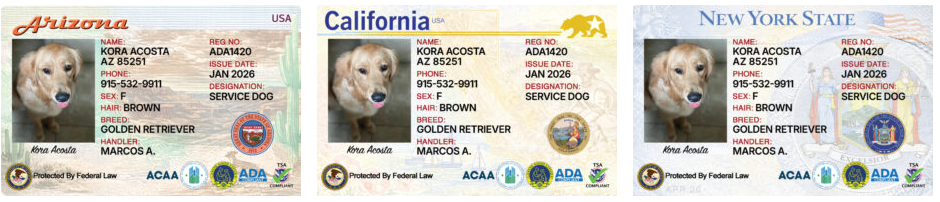
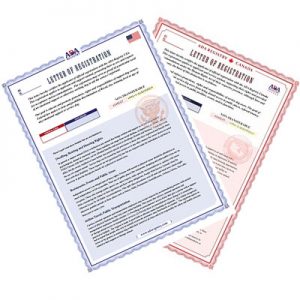
Example Cards Available In USA And Canada

Overview of Service Dog and Legal Definitions in Rhode Island
What is a Service Dog?
A service dog is specifically trained to perform tasks directly related to a person’s disability. The primary role of a service dog is to aid individuals who face challenges due to physical or mental conditions. In Rhode Island, as in other states, the definition aligns with the federal understanding provided by the Americans with Disabilities Act (ADA). These animals are not pets; they are working animals with skills specifically tailored to assist their handlers. Tasks they might perform include guiding individuals who are visually impaired, alerting people who are deaf, pulling a wheelchair, alerting and protecting a person having a seizure, or reminding a person with mental illness to take prescribed medications.
How Service Dogs Differ from Other Types of Assistance Animals
Service dogs differ from other types of assistance animals, such as emotional support animals (ESAs) and therapy dogs, mainly due to their training and the specific tasks they perform. Unlike ESAs, which are primarily for providing comfort through companionship, service dogs have undergone rigorous training to perform specific tasks that directly relate to their handler’s disability. Therapy dogs provide psychological or physiological therapy to individuals other than their handlers and are often found in schools, hospitals, and nursing homes. Notably, service dogs are afforded broader access rights under both federal and state laws compared to emotional support or therapy animals.
Key Federal Laws Affecting Service Dogs (e.g., ADA, FHA, ACAA)
Several federal laws are pertinent to service dogs and their handlers. The ADA ensures public access rights, obligating facilities open to the public to accommodate service dogs. The Fair Housing Act (FHA) protects residents who require assistance animals, including service dogs, in housing scenarios, while the Air Carrier Access Act (ACAA) addresses accommodations in air travel. These laws require that service dogs be allowed in most areas where the public is permitted and prohibit discrimination against individuals with disabilities who use service dogs.
State-Specific Service Dog Laws in Rhode Island
Housing Rights and Responsibilities
In Rhode Island, housing rights for service dog handlers align closely with federal mandates outlined by the FHA. Landlords must make reasonable modifications to policies to allow service animals without imposing pet fees or deposits. While emotional support animals are also covered under housing provisions, service dogs receive additional legal consideration due to the critical tasks they perform for their handlers. Housing providers can request confirmation of disability and the necessity of the service animal if the disability or required task is not readily apparent.
Public Access and Accommodation
Public access regulations in Rhode Island require that service dogs be permitted to accompany their handlers anywhere the public is allowed. This right extends to restaurants, hotels, retail stores, and other businesses. Rhode Island law mandates that staff may only inquire if the dog is required due to a disability and what tasks the dog has been trained to perform. Businesses are not allowed to require documentation for the service dog or impose fees or surcharges tied to the presence of the service animal.
Transportation and Travel Rules
Service dogs in Rhode Island are protected under similar federal guidelines as other states regarding transportation. Public and private transportation services, including buses, taxis, and shuttles, must accommodate service dogs, providing them the same access privileges as their handlers. When it concerns air travel, service dogs are covered under the ACAA, allowing them to board and travel with their handlers, typically without additional charges or restrictions, provided they meet airline-specific requirements.
Employment and Workplace Considerations
Employment laws under the ADA cover service dogs in the workplace, and Rhode Island adheres to these provisions. Employers are required to provide reasonable accommodations for employees who rely on service dogs unless doing so would cause undue hardship. Employees should engage in a direct dialogue with employers to discuss their needs and how their service dog will assist them in performing job functions. Employers cannot demand medical documentation or training certificates for the service dog but may discuss potential accommodations necessary for the service animal in the workplace.
Register Any Breed
Example Cards Available In USA And Canada
Documentation, Requirements, and Processes in Rhode Island
Service Dog Documentation and Who Can Issue It
While federal and state laws generally do not mandate specific documentation for service dogs, handlers may still encounter situations where having such documents can ease interactions, particularly regarding housing and air travel. In Rhode Island, health professionals, such as doctors, therapists, or certifying agency representatives, traditionally provide acknowledgment of a handler’s need for a service dog to prevent potential conflicts, although these are not legally required by public accommodations.
Landlord, Business, and Provider Verification Rules
Rhode Island laws and the ADA restrict entities from demanding proof of a service dog’s training or licensing. Businesses and landlords can only ask if a dog is required for a disability and what task it has been trained to perform. Verification from landlords, businesses, or service providers typically involves understanding these legal boundaries to avoid infringing on handler rights and provoking legal challenges. Documentation reflecting the handler’s disability may be requested more frequently in housing situations under FHA guidelines.
Rights, Limitations, and Legal Risks
Rights Service Dog Handlers Have in Rhode Island
Service dog handlers in Rhode Island benefit from numerous protective rights, ensuring equitable access to housing, public spaces, and transportation. They have the right to without discrimination due to their service dog and are entitled to the same use of facilities as any other member of the public. They are not required to provide additional services beyond those mandated for other customers or tenants.
Limits on Service Dog Protections and Common Restrictions
While protections are extensive, there are limits on where service dogs can go. In locations where the safety or integrity of goods and services might be compromised, such as certain sterile areas in hospitals, access may be restricted. Additionally, the handler can be asked to remove the service dog if the animal is out of control and the handler does not take effective action to control it, or if the dog poses a direct threat to the health or safety of others.
Penalties for Fraud or Misrepresentation
Rhode Island imposes penalties for misrepresenting a pet as a service dog, reflecting broader efforts to protect the integrity of services provided to people with disabilities. Misrepresentation can lead to fines or other legal actions, aiming to deter individuals from exploiting laws designed to help those with legitimate needs.
Practical Guidance for Service Dog Handlers in Rhode Island
How to Qualify for a Service Dog Legitimately
To legitimately qualify for a service dog in Rhode Island, an individual must be diagnosed with a disability and require a specific task performed by a service dog. This may involve consulting with health professionals who can recommend a service animal, followed by engaging with a certified trainer or organization specializing in preparing service dogs.
How to Talk to Landlords, Airlines, and Employers
Communication is key when interacting with landlords, airlines, and employers. Handlers should disclose their need for a service dog, clarify the tasks the dog is trained to perform, and discuss any accommodations required. Preparing a letter from a healthcare provider might assist in housing or workplace discussions, even if not mandatory, to help expedite the process.
Summary of Service Dog Laws in Rhode Island
In summary, service dog laws in Rhode Island are designed to uphold the federal standards set forth by the ADA, FHA, and ACAA, while also instituting state-specific nuances in housing and public access. Handlers are granted comprehensive rights regarding accommodation and access, though they also have responsibilities to ensure their dogs are well-behaved and do not pose health or safety threats.
Key Points for Service Dog Handlers in Rhode Island:
- Understand the definition and distinction of a service dog as a working animal trained for specific tasks.
- Recognize federal and state laws that protect service dog handlers, including ADA, FHA, and ACAA.
- Be informed about rights related to housing, public access, transportation, and employment.
- Bear in mind the documentation commonly accepted to prevent potential conflicts.
- Adhere to ethical guidelines by avoiding misrepresentation of pets as service animals to prevent legal penalties.
- Engage in clear communication with landlords, businesses, and employers to ensure mutual understanding and compliance with the law.
Overall, Rhode Island maintains a supportive legal environment for service dog handlers, aligning significantly with federal statutes and offering additional local guidance to facilitate their use in everyday life.


-
Public Access Kits
$149.00 Learn more This product has multiple variants. The options may be chosen on the product page -
Quick Ship Premium Vests
$48.00 – $82.00 Learn more This product has multiple variants. The options may be chosen on the product page -
Service Dog Bandana
$39.95 Learn more This product has multiple variants. The options may be chosen on the product page
Custom ID Cards

Custom ID Cards
All States
Canada Cards

Custom Service Dog Tags

Official Dog Vests

Smart Vests
Official Public Access Kits
Complete Kits
USA & CANADA Letters
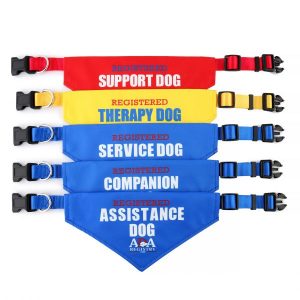
High Quality Bandanas
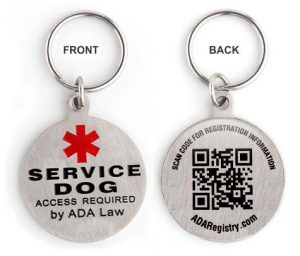
Service Dog Tags
Smart Tags
ESA TAGS